
Small airport. Big challenges.
NW Washington travelers see fewer direct destinations. For now.

Our agenda.
Bellingham International Airport’s hopes for business travel — with results of a new BLI business survey. Unemployment stats. Flat(ish)-to-falling residential home prices. And recent messiness in the business of local news. Let’s start Franksplaining Business.
Small airport. Big challenges.
Is Bellingham International Airport in Washington state a business airport? It depends on whether business travelers mind connections — and how broadly you define “business.”
Yet a new survey coupled with efforts to get a grant-based airline incentive program off the ground intend to reverse declining destination and passenger counts at Northwest Washington’s commercial jet passenger airport.
First, some background. Bellingham (aka BLI), tucked into the upper left corner of the upper left contiguous U.S., currently has two national carriers, Alaska Airlines and Allegiant Air. They fly to a handful of destinations nonstop. Alaska, through Horizon Air or SkyWest flights, serves Seattle and — starting this year — Portland. Allegiant serves Las Vegas, Phoenix-Mesa and Burbank after ending or suspending service over the past several months to Oakland, Palm Springs and San Diego.
Perhaps most important to business travelers, Alaska’s service is daily, with Seattle and Portland hubs for ongoing connections. Allegiant, which focuses on leisure travelers, flies to its three destinations only a few times each week.
Following Allegiant’s April announcement that it would close its crew base of nearly two decades at BLI this November, it made the Burbank service seasonal. No flights are available to book after mid-August. That leaves only Las Vegas and Phoenix-Mesa as year-round Allegiant destinations.
But Alaska, which began its Portland flights in March, will add a regular second daily PDX flight in November and, as Port of Bellingham spokesman Mike Hogan told me in May, “the increased PDX service will have no impact on SEA, where Alaska intends to maintain 3x flights.”
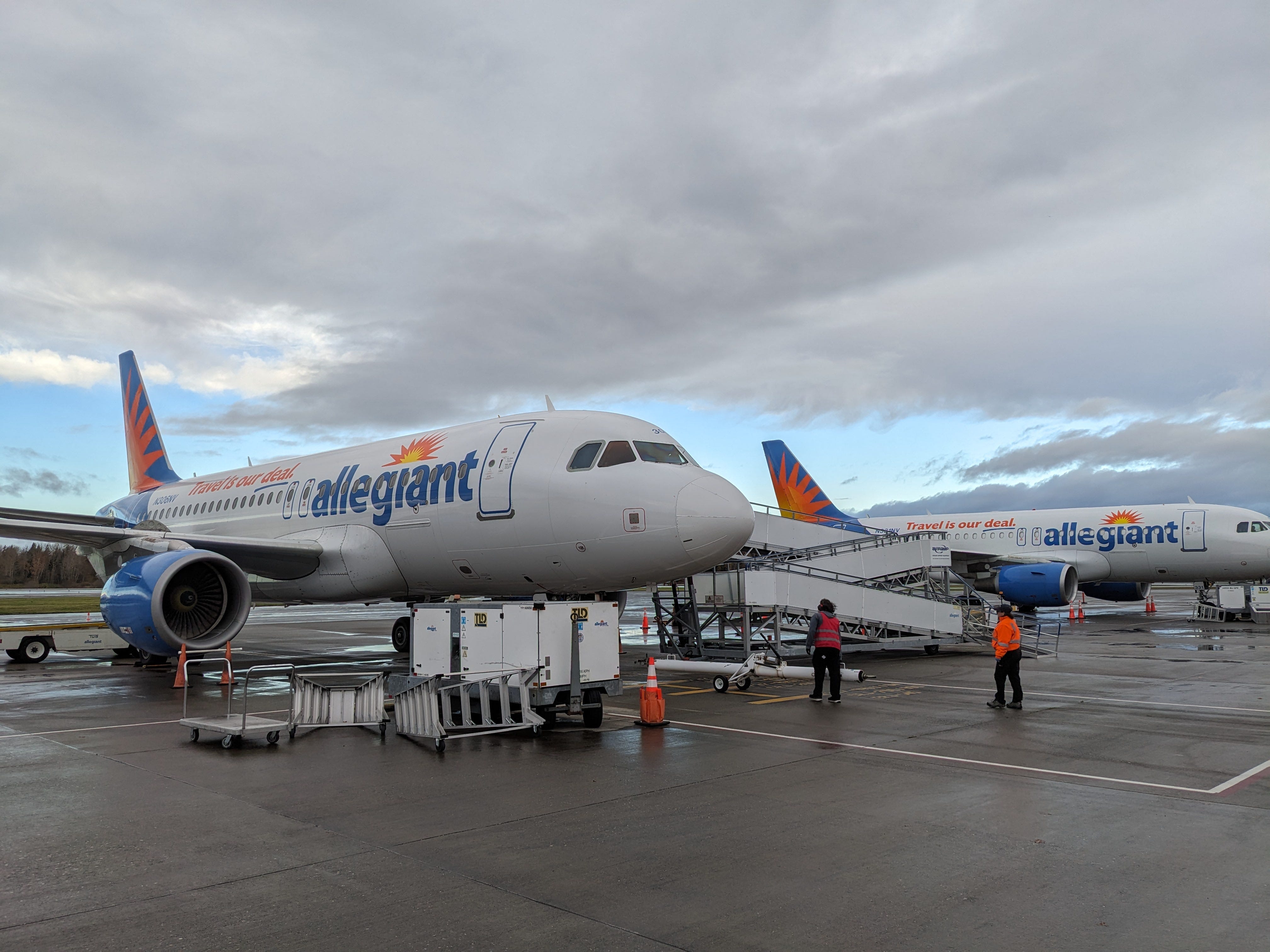
Pulling up from a descent
Still, it’s a lot of destination churn that can’t disguise one trend: BLI’s passenger counts have been declining over the past few years.
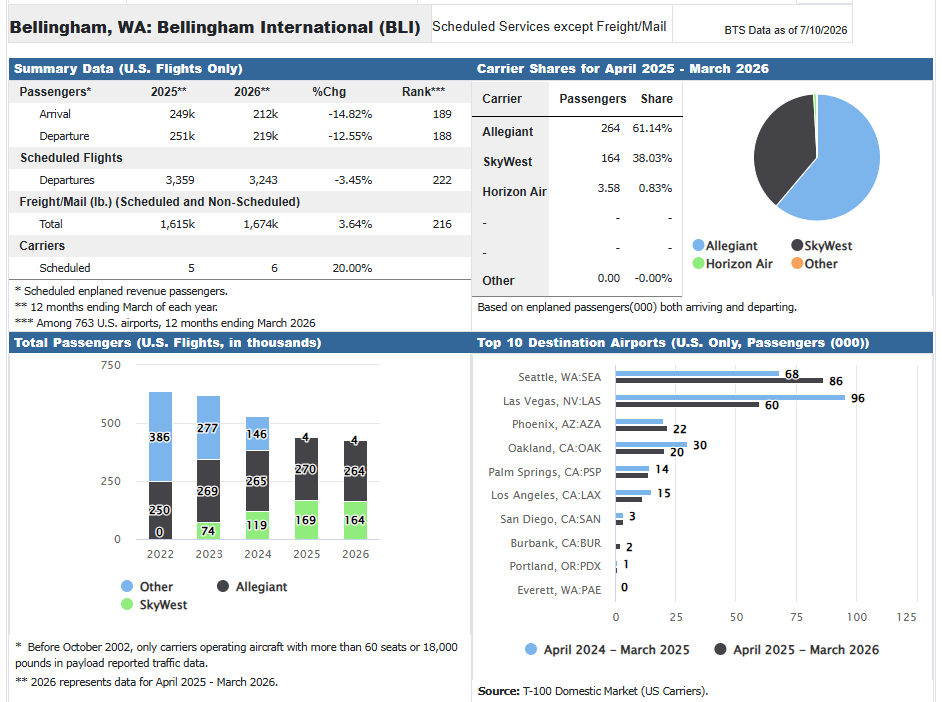
According to data from the U.S. Bureau of Transportation Statistics, BLI’s total arriving and departing passengers for the 12 months ending March 2026 (the most recent month available as of July 9) slipped to 431,000 compared to 500,000 for the same period a year earlier and 609,000 in 2024. BLI’s rank among airports nationally has similarly dropped to 188 for passenger departures this year, from 183 in 2025 and 168 in 2024.
By comparison, the passenger terminal at Seattle Paine Field in Everett (PAE) ranked 173 in BTS stats for the 12 months ending in March 2026 and handled 630,000 passenger arrivals and departures.
Perhaps not surprisingly, BLI’s decline follows the departure of Southwest Airlines. In the twelve-month window ending March 2024, Southwest accounted for 41% of passengers, Allegiant 44% and Alaska 15%. Fast forward past Southwest’s final Bellingham service in August 2024 and by March 2026 the trailing year’s data puts Allegiant at the top, with 61% passenger share, and Alaska at 39%.
But those 2026 numbers were before Allegiant ceased service to Oakland in May and curtailed its flights to other destinations.
New business survey casts light
History and statistics aside, how does BLI regain what it recently lost? And what do business travelers want from it?
To find out, the Port of Bellingham fielded a survey between March and June of this year (promoted through the Bellingham Regional Chamber of Commerce) with a dozen questions aimed specifically at the regional business community.
The results, shared with me in early July by Port of Bellingham officials, provide insight into gaps and potential opportunities for airlines that BLI is courting.
The most frequent destinations for business travelers in the region today? Out of 21 listed (plus “other”), the top five in descending order were the San Francisco/San Jose area, Portland, Los Angeles, Denver and Chicago.
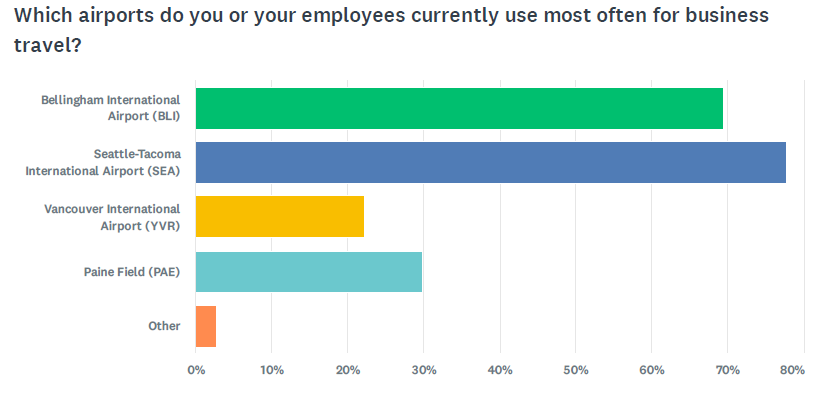
The airports used most often by area business travelers? Seattle/SEA (nearly 80%), followed by Bellingham/BLI (nearly 70%), Paine Field/PAE (about 30%) and Vancouver, B.C./YVR (more than 20%).
The importance of additional nonstop destinations from BLI? Nearly 60% rated that as “very important” or “critical” for their business, the top two choices on a five-point scale.
BLI Director of Aviation Matt Rodriguez said the 144 survey responses solicited from BLI’s “catchment,” or market, area of Whatcom, Skagit, Island, San Juan and part of Snohomish counties will help with discussions at air service conferences and when meeting with airlines.
That catchment area, Rodriguez said, lost over 70% of its passengers in 2025 to Seattle due to a lack of available routes. SEA is a 100-mile drive from Bellingham.
“The bottom line is that our community deserves more air service. BLI is currently in a vise,” he said. “We have long relied on our Canadian neighbors to the north using our airport, but the unfavorable currency exchange rate and political tensions between the two countries have reduced the number of Canadians coming down to use BLI.”
Instead, he said, the airport wants to pull more travelers to BLI from south of the border, cutting the percentage in Northwest Washington that choose SEA.
“Our goal over the next five years is to reduce that figure by 25% or more,” he said.
A pending airline grant
One strategy is to backstop airlines offering new service by providing what’s known as a community “Minimum Revenue Guarantee” (something that more than 70% of those in BLI’s business survey weren’t familiar with). In essence, an MRG offsets the carrier’s costs if the routes don’t meet agreed-upon dollar or passenger thresholds.
“It sweetens the pot and it removes the risk on the airline’s behalf for a startup route or a route that’s been previously served,” he said. But it’s only intended as a short-term measure, not to “subsidize a desired route that does not have the demand support for it.”
Rodriguez said BLI applied this year for a roughly $850,000 grant from the U.S. Department of Transportation’s Small Community Air Service Development Program. If awarded — and he hopes to hear in August or September — that money could be combined with other community cash, perhaps from business organizations, to fund an MRG program and attract airlines. Other levers he said BLI could pull are waivers of landing, terminal use and other fees, all within a potential incentive package.
For its part, existing carrier Alaska Airlines said it’s already been beefing up its service and onward destinations through Portland as it’s increased frequency from BLI.
“By this fall, Alaska will offer 50% more seats in Portland than it did just two years ago, reflecting strong travel demand and the airline’s continued investment in the market,” said Alaska’s Ray Lane. “If the new route between BLI and PDX proves successful, we hope to continue expanding our presence at BLI.”
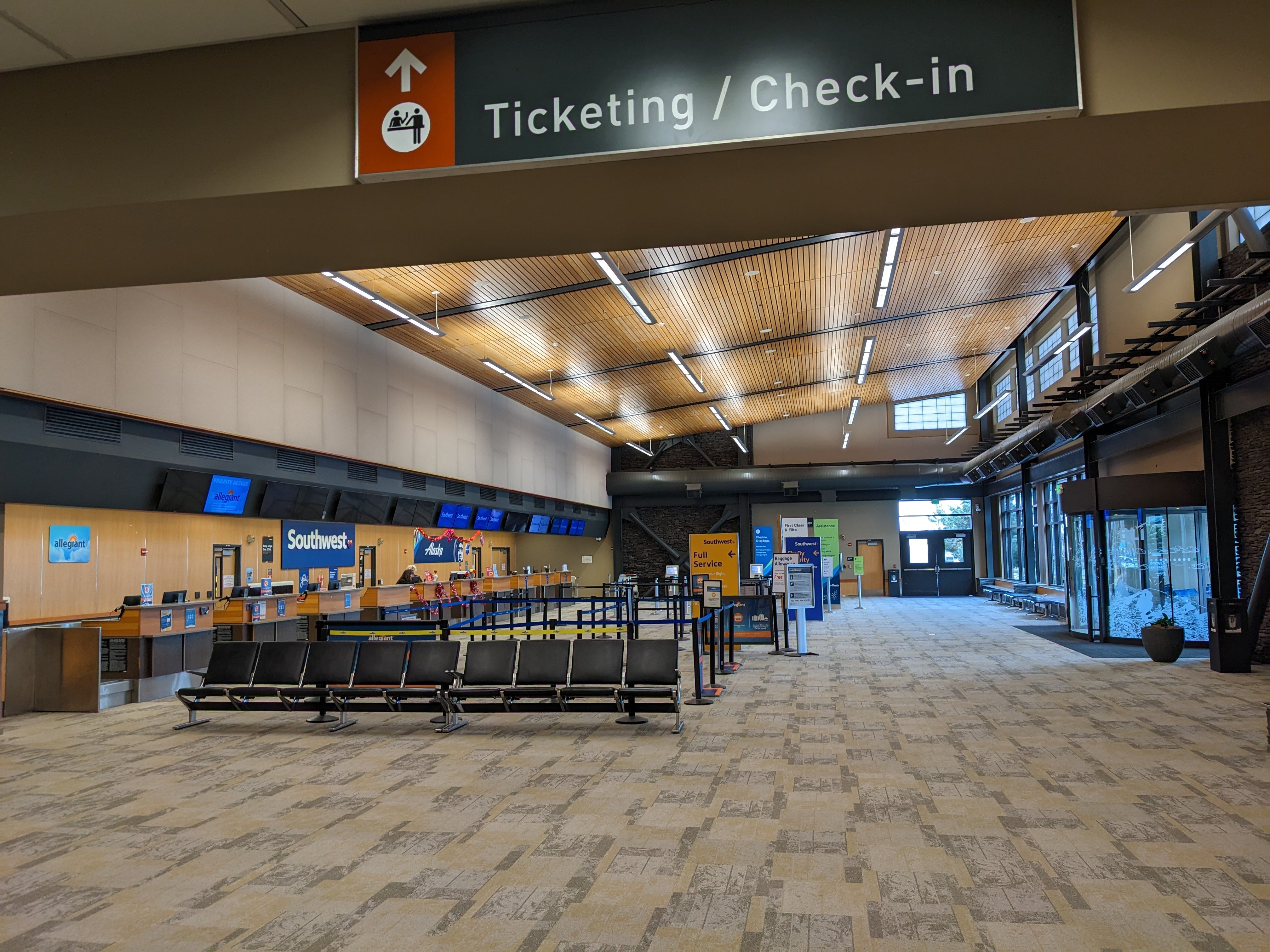
Connections, buses and determination
Meanwhile, business travelers appear to be making do.
Guy Occhiogrosso, Bellingham Regional Chamber’s president and CEO (and member of the Port’s Bellingham International Airport Advisory Committee), considers BLI the “convenient option” until it gets more airlines or routes, balancing a likely need for a flight connection with easier parking and security than a drive to SEA.
He also said that companies located in the area have inbound corporate travelers, and the airport “is an amenity that we can’t overlook or devalue.”
Lori Reese, marketing and tours manager for Bellair Airporter Shuttle, said they have “a large audience” of business travelers who take Bellair’s buses headed from the Bellingham area to SEA and back. It’s about a three-hour freeway connection.
“Many like being able to work or just relax during the shuttle drive,” she said.
And perhaps it helps, a little, to know that BLI is not alone in its challenges.
“It’s very, very common,” Rodriguez said, namechecking other small airports close to large airline hubs, including Fort Collins, Colorado near Denver and even Paine Field in Seattle’s shadow.
“It’s just really how you manage the marketing of your own airport and how well you advocate for additional routes to the airline,” he said. “A lot of people want to use BLI, so they’re excited to have more connecting routes, but we need those direct routes. That’s what’s going to help out the community and the airport.”
County unemployment and unemployed up year over year.
May jobless data for Whatcom and Skagit counties in Northwest Washington, released by the state Employment Security Department late last month, shows unemployment rates dropping from April — yet higher than May a year ago. Whatcom’s non-seasonally adjusted May rate was 4.5%, down from 4.8% in April. Skagit’s was 5% in May, down from 5.2% in April.
But, notably, both notched hikes over May 2025, when Whatcom County’s rate was 4% and Skagit County’s was 4.4%.
The year-to-year comparison also showed an increase in the absolute number of unemployed. Whatcom County’s count was 5,264 people, up from 4,543; Skagit County’s May 2026 tally was 3,037, up from 2,613 in May 2025.
Also up? The labor force in each county, which is defined as the number of people age 16 and older working or actively looking for work.
Nearby, May’s unemployment rate in San Juan County was 3.8%, Island County was 4.7%, Snohomish County was 4.9% and Seattle’s home of King County was 4.7%.
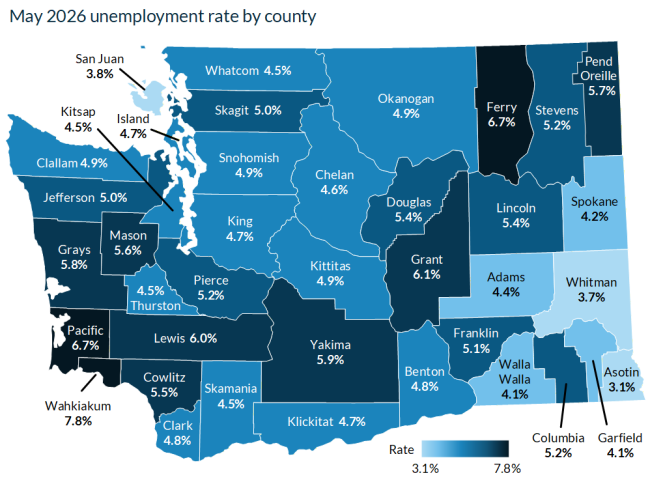
Unlikely to help future stats in Whatcom County was news early this month that Alpha Technologies Services would be closing its Bellingham operations facility on October 15 and laying off 75 people.
In a WARN letter filed with the state, publicly traded parent company EnerSys said the first layoffs were expected on August 31. The only reason EnerSys gave in its letter was “this closure is the result of and will result in the relocation and/or contracting out of company operations and/or employee positions.”
Whatcom home prices up a little; Skagit’s fall.
New analyses of Northwest Multiple Listing Service data find second quarter median home sale prices heading in different directions, overall, in Whatcom and Skagit counties.
Whatcom County’s median price was $640,500, up 1% from the same quarter a year ago. But Skagit County’s median was $605,750, down 3.9% for Q2 year over year.
Peter Ahn of NextHome Northwest Living in Bellingham did the math in the two reports. He said that increased inventory and higher mortgage rates have pushed the average time to sell a home to 46 days in Whatcom County, up 24% from the second quarter in 2025. Skagit County’s days-on-market number was up, too, but not as much: 37 days, a 6% increase.
The priciest places? Based on the reports’ median sales figures, Anacortes ($785,000) and Bellingham ($755,500) followed by a slew of locations in the $600s: Lynden ($635,000), Ferndale ($629,000), Mount Vernon ($625,000), Nooksack Valley ($617,500) and Sudden Valley ($609,950).
Ahn called out Sudden Valley “as a great option for buyers looking to remain in Bellingham due to its prices” because of its proximity.
A separate Whatcom County analysis from Tiffany Ng at Bellingham Real Estate Co. said that 2026 was typical for its surge of inventory, or homes listed for sale, in a year’s second quarter. However, Ng notes, “the high supply was not met with high demand.”
Local news is a messy business.
The first half of 2026 ended with something local news organizations generally don’t like: becoming news.
But journalism is also a business. It can be a difficult one. Nationwide, shutdowns over the last two decades have eliminated nearly 40% of all local U.S. newspapers and layoffs have thinned the ranks of many which remain.
Fortunately, no new cullings of the herd have occurred in Whatcom or Skagit counties. But drama? Lots, in a compressed time period.
First: The Bellingham Herald’s news staff ratified a new contract at the end of June, one of five newspapers in Washington and Idaho covered by the deal with corporate owner McClatchy Media. The Pacific Northwest Newspaper Guild said in an email announcement that the agreement included raises, a $52,000 minimum salary for current employees and a “ban on AI being used to replace staff, decrease pay or reduce working hours.”
The dispute first led to a byline strike over artificial intelligence in news writing (which caught the attention of the New York Times), then a one-day, real-world strike with picketing in May at the Herald, The Olympian, Tacoma News Tribune, Tri-City Herald and Idaho Statesman before the contract agreement.
Second: The all-digital, nonprofit Salish Current both gained, and lost, an executive director between January and May. Kari Mar — who also has leadership roles with The Northern Light in Blaine and La Conner Community News in La Conner — announced her executive director role at Salish Current in January. But in a late June post on Substack, Mar wrote that after having “acquired nine legacy media publications across Skagit and Whatcom counties” she “ultimately stepped away from the publication that required the most work: Salish Current.”
Mike Sato, co-founder and executive editor of Salish Current, confirmed Mar’s departure, saying the resignation came in a late-night email to its board president on May 7. Sato wrote me that he, along with publisher and founder Amy Nelson, are currently leading the organization and working with the board on a leadership transition.
Third: Not to leave out a development with personal resonance, the owner of Bellingham-based Cascadia Daily News fired founding executive editor Ron Judd at the end of May over what Judd publicly described as “irreconcilable differences.” Much has been written about this, including by readers in the CDN letters section, Seattle Times’ Free Press editor Brier Dudley and Ron himself (in his new and highly readable Substack newsletter).
As CDN’s business contributor of four years — and freelance, not staff, so not dependent on Cascadia Daily News for salary and benefits — I decided to follow Ron out the door a week later. He had been my direct editor and the reason I joined the news startup originally. I went into more detail on LinkedIn, but suffice it to know that leaving was the right thing to do, for me. I still subscribe and cheer on the newsroom. But my business writing? Well … it’s here.
Getting into others’ business.
Hat tips to these journalists and news orgs for recent business coverage I found fascinating (one possible paywall ahead):
“What a Monopoly importer learned when it tried to make things in the U.S.A.” NPR economics reporter Scott Horsley details, step by step, WS Game Company’s attempt to make a custom, 250th birthday edition of Monopoly fully in the U.S. to avoid punishing tariffs. Spoiler alert: no dice.
“Yes, we have 8,282 manufacturers in WA. They actually make things.” Erik Lacitis in Seattle Times’ Pacific NW Magazine cover story profiled three small manufacturers, including Goodwinds Composites in Mount Vernon, Skagit County. Goodwinds has made composites for everything from pool cues to legs on the Ingenuity Mars Helicopter.
“This factory was severely short on workers. Then it offered flexible work.” Andrea Hsu of NPR reported on how a short-term COVID-19 pandemic workaround at Roper Corp. (part of GE Appliances) in Georgia turned into a longer-term fix for filling manufacturing shifts, encouraging experienced workers to stay and attracting new workers who need flexibility. Think a pool of more than 900 workers, four-hour shifts and app scheduling.
I read everything.
Write to me with your comments or ideas. A human — me — reads, researches and writes everything. It’s an AI-free zone. I’m reachable directly at franksplaining@substack.com. Or leave a comment at the bottom of this newsletter post on Substack.
And please share this newsletter freely. I encourage it, to anyone interested in business through a Northwest Washington lens. The more sharing and subscribers (even free), the more I’m encouraged to keep writing it.
Back in a couple of weeks with some short takes. Read me then.
Who’s writing this? Frank Catalano is an award-winning writer and broadcaster. Most recently, he was the regular business contributor and columnist for Cascadia Daily News in Northwest Washington from June 2022 to June 2026.
Earlier, Frank had side gigs as a columnist for, or ongoing contributor to, GeekWire, EdSurge, Seattle Weekly, Puget Sound Business Journal and KCPQ-TV Seattle. He started in radio news, spent decades as a senior executive and consultant in the tech and edtech industries, then returned to journalism. Reach Frank at franksplaining@substack.com.
Good piece on BLI. I am curious about the status of the large loan the Port took out about 14 years ago to fund major terminal improvements. There was a split among the commissioners about whether it was best to pay cash and do the work in phases or borrow against future BLI revenue. There was acknowledgment that airlines and routes are fickle and counting on growing revenue was either clever or risky. Ultimately they went with the full project and the loan.